Zander AridGrow Mycorrhiza
Six strains of root fungus, selected out of saline arid ground, that take over the running of the plant.
AridGrow is an assemblage of six strains of mycorrhizal fungi, selected for their tolerance of the conditions that defeat everything else: salinity, sodicity, adverse pH and contamination.
Around 95% of plant species have a relationship with the soil that runs through a fungus. For most agricultural crops these are endomycorrhiza, derived from a single genus, Glomus. The various species and strains grow literally into the root cortex of the crop and take sugar from photosynthesis.
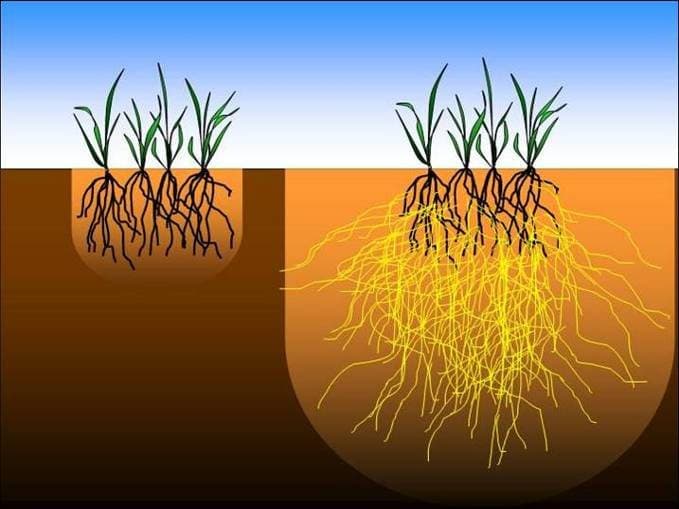
The bargain takes six weeks
For the first few weeks the host plant grows weakly — it is paying for something it has not yet received. Then the fungus develops a complex mycelium capable of capturing both upwelling water and nutrients that bacteria on the surface of the individual hyphae dissolve out of insoluble sources. Strong growth follows.
After a further six weeks the mycorrhiza has effectively taken over the husbandry of the plant. It means the host becomes far less dependent on artificial irrigation — as much as 93% less than a conventionally irrigated crop, a figure the put to the test on desert ground alongside one of the largest olive farms in the world.
Because the mycorrhiza is actively forming soluble nutrients in the rooting zone, artificial fertilisers are not needed. Phosphorus-based fertiliser will inhibit the mycorrhiza altogether — this is the one incompatibility that matters, and it is worth saying plainly.
Application
The product is added to the root ball either by dipping or by sprinkling grains onto the exposed roots — about 10 g per plant for a tree transplant. For seed, larger kinds such as maize, beans and tree seed can be steeped in dilute and inoculated before sowing; for small there is a coating technology that keeps the spore dry until it is in the ground.
What it also does
Once established, the mycelium can form a stocking-like structure around the crop's roots which protects against pests such as root-knot eelworm and diseases including Fusarium, Pythium and Phytophthora. It also produces a glyco-protein waste, glomalin, which is itself a durable contributor to soil organic matter — the soil gets better while the crop grows.
More broadly, mycorrhiza can restore soil status after an episode of disruption: a wide crude-oil leak, a sudden rise in salinity after a breach in sea defences, an accidental discharge of industrial liquid onto farmland. As Le Chatelier's principle has it — after a perturbation, nature seeks equilibrium.
Source — Zander Corporation technical notes; Al Jouf interim report
← All entries