Al Jouf, Saudi Arabia — olives
Ten months, in the desert, against a control on better ground. The treated trees drew 92.8% less water and caught up anyway.
Al Jouf Agricultural Development Company holds the world record for the largest modern olive farm — some five million trees, irrigated from deep wells drawing water that flows from the Jordanian mountains beneath a saline desert towards the Red Sea. Alongside them stand considerable plantations of peach, nectarine and other top fruit.
There is real uncertainty as to whether that water supply will hold out, and a water abstraction tax across 326 wells has made the question a commercial one as well as an agronomic one. The trial ran from December 2017, with data collected over the following ten months and an end-of-season review in September 2018.
Design
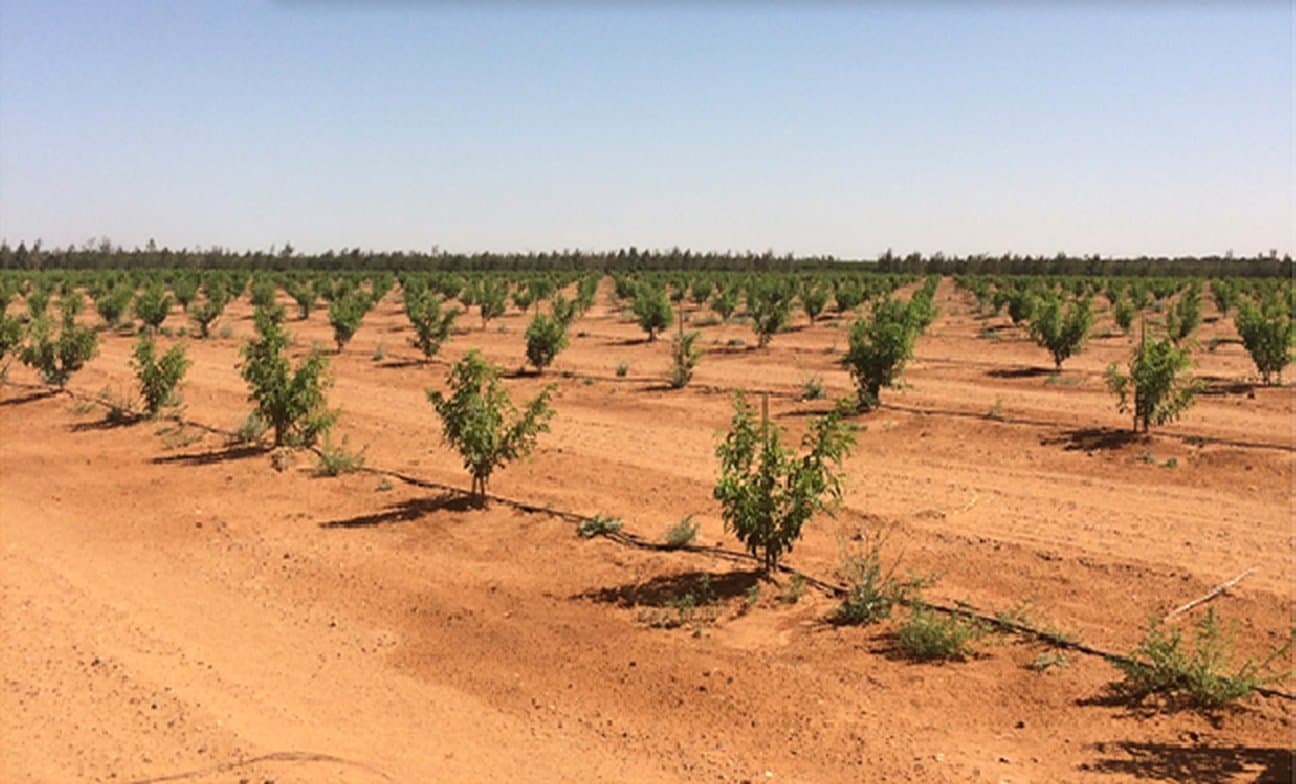
Three rows of seventy one-year-old olive trees were planted on desert ground adjacent to a newly planted block. A further row was planted at the same time and managed conventionally, for comparison. Critically, the conventional row stood on a substratum that had already supported an irrigated crop such as maize, so its salt levels had been washed down — the control had the better ground throughout.
Each Zander tree received around the lower two-thirds of the root ball and just two litres of mixed at roughly one part to four with the native soil.
| Plot | Months 1–5 | Months 6–9 |
|---|---|---|
| Zander 1 | 15 litres / 15 days | 15 litres / 15 days |
| Zander 2 | 15 litres / 15 days | 15 litres / 20 days |
| Zander 3 | 15 litres / 15 days | 15 litres / 25 days |
| Traditional | 14 litres every day | 14 litres every day |
Result
| System | Per tree / year | Per 100,000 trees / year | Difference |
|---|---|---|---|
| Traditional | 5,110 L | 511,000,000 L | — |
| Zander 1 | 360 L | 36,000,000 L | −92.8% |
There were minor setbacks at the outset. Salt was present before the mycorrhiza had established, and the watering method itself tended to concentrate it at root level. By week ten both sets of trees had begun to develop — the conventional ones on daily water and low-salt ground, the Zander ones because their mycorrhizal association was by then active and working in the more saline substratum.
Zander foliage was markedly darker green, denoting more chloroplasts and greater resilience; the paler conventional foliage reflected the faster early growth that daily irrigation had bought. The line of best fit showed the Zander trees mirroring the conventional ones and still climbing. By the time the report was written they had overtaken them — repeating what earlier avocado and mango trials in Spain had shown: a slow start, then a pass.
Source — Al Jouf Agricultural Company: Interim Report on a Trial to Cultivate Olive Trees Using Zander Technology. Jointly authored by Zander Corporation and JADCO, September 2018
← All entries