Decontamination
The same ion-grabbing chemistry that holds salt away from a root will hold lead, mercury and uranium out of water.
Contamination of soils and watercourses comes about through the natural solubilising of metal salts, and through the concentration of certain aromatic organic substances which are themselves soluble and often highly toxic.
has a high propensity for ion capture: ligands in the organic structure seize the ions of heavy metals and hold them — chelation. Release is only possible given a significant change in the pH of the aqueous medium.
What the column tests showed
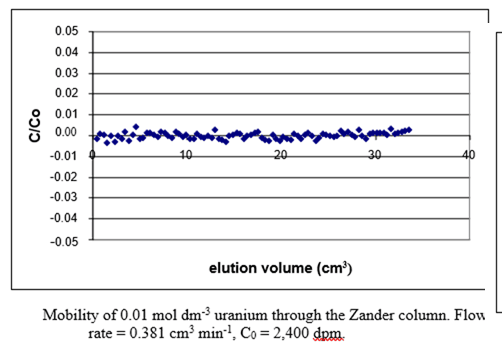
Tests have been carried out on a range of heavy metals, metalloids and bases. Zander humus placed in high concentrations of metals in solutions of their salts removed more than 99%, the metal ending up in the humus matrix. Lead and mercury were removed easily.
Some elements are fickle — cadmium and zinc among them — and the problem becomes an engineering one, requiring more than one pass through the filter bed. Counter-intuitively, the lighter metals, those with an atomic weight below zinc, proved more tenacious than the heavy ones.
Reed beds for the difficult end
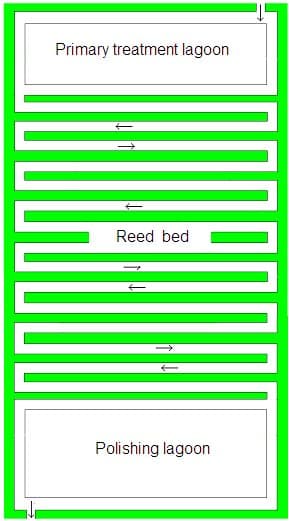
For the lighter metals, earlier research showed that the actively growing roots of reeds and other submersed aquatic plants remove very significant amounts of metal ion when contaminated water is passed through a reed bed. Zander humus is placed in both the primary treatment and the polishing lagoon; the reed bed does the work between them.
Radioactivity, PAHs, PCBs and drill cuttings
Zander has been used to remove radioactivity from a number of sources, not least at Chernobyl in Ukraine, where bunds were built from the material to contain it.
For organic contaminants such as PAHs and PCBs, Zander humus acts as a microfine filter: individual molecules of these long-chain substances are caught up in the Zander colloids and taken out of circulation. Where contamination is widespread but shallow, dilute can be applied as a drench over the affected ground, with chelation achieved by the active organic molecules.

Source — Zander Corporation technical notes
← All entries